The University of Iowa
The College of Liberal Arts and Sciences
Spring 2025
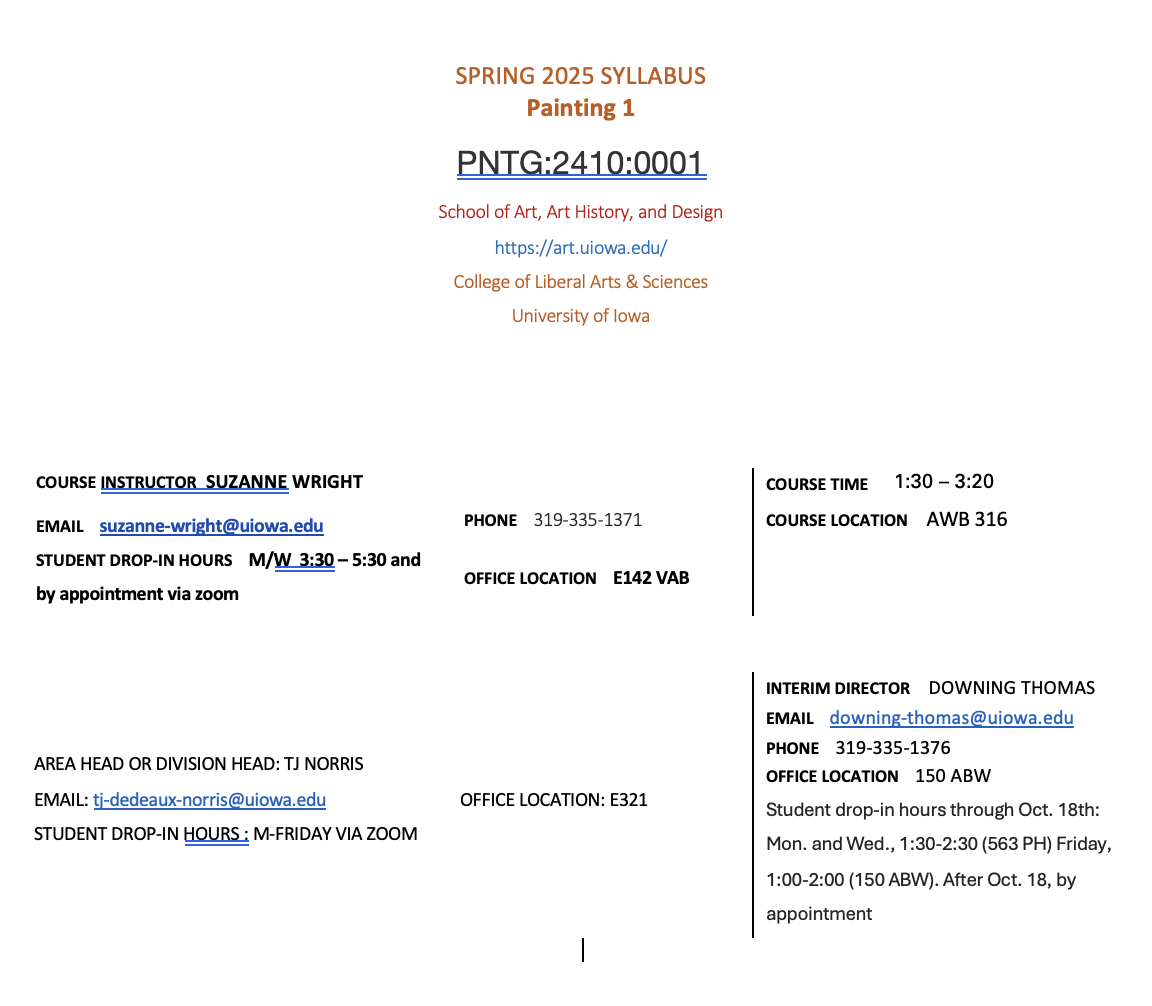
Title of Course: Beginning Painting PNTG:2410:0001
Course meeting time and place: Painting I - 1:30 - 3:20
Monday/Wednesday Art Building West 3rd floor studio 316
Department of Department of Painting and Drawing: https://art.uiowa.edu/
Course ICON site :https://icon.uiowa.edu/instructor
Course ICON site: To access the course site, log into Iowa Courses Online (ICON) using your Hawk ID and password.
Course Home
For Undergraduate Courses: The College of Liberal Arts and Sciences (CLAS) is the home of this course, and CLAS governs the add and drop deadlines, academic misconduct policies, and other undergraduate policies and procedures. Other UI colleges may have different policies.
For Graduate Courses: The College of Liberal Arts and Sciences (CLAS) is the home of this course, and CLAS governs the policies and procedures for its courses. Graduate students, however, must adhere to the academic deadlines set by the Graduate College.
Instructor Contact Information
Office location:
Student drop-in hours:
Assistant Professor Suzanne Wright
Office location: Visual Arts Building: VAB
Student drop-in hours: Instructors: Office hours M/W 12:00 – 1:30
Students are invited to drop by during these hours to discuss questions about the course material or concerns. I am also available by appointment if you are unable to attend my drop-in hours and may be available for zoom meetings.
Phone: 319-335-1371
E-mail: suzanne-wright@uiowa.edu
Departmental Executive Officer (DEO): Downing Thomas
Interim Director Downing Thomas, email downing-thomas@uiowa.edu
Phone 319-335-1376
Office Location 150 ABW, Student drop-in hours through Oct. 18th: Mon. and Wed., 1:30-2:30 (563 PH) Friday, 1:00-2:00 (150 ABW). After Oct. 18, by appointment The DEO is responsible for supervising the delivery of courses in their department.
Course Supervisor [only for classes that have a course supervisor]:
Office and hours:
Phone and e-mail:
Description of Course
This course is an introduction to the materials and techniques used in painting with an emphasis on oil painting. An exploration highlighting the materiality of paint and physicality of mark making. Students are introduced to color theory, glazing, impasto, figuration and abstraction. This is an introductory studio art class providing beginning students with instruction in the media techniques, aesthetics, theory, and historical influences of contemporary painting. This course will cover the fundamentals of painting ranging from color mixing, transparencies and opacities, gestural painting, representation, abstraction, and color theory. By introducing a variety of painting techniques in junction with slide presentations of working and historical artists the students will gain a solid understanding and studio capability of many styles of working. Demonstrations of painting techniques will be given in class that will help to break down the formal components of painting including; light, color, line, scale vs. size, brush weight, gesture, transparent vs. opaque, texture, etc. There will be group discussions and critiques based on paintings made in class and weekly assignments to work on at home. Students will be given the opportunity to participate in a field trip to local galleries or a museum. This course is set up for experimentation and technical expansion. Many students are good at painting in a certain way, or have an idea of how they would like to paint. This class is developed to expand your visual and technical horizons so you will become fascicle in many modes of representation. It is important that you experiment and become fluent with many different materials so you can communicate your visual idea and master the various techniques of painting.
Learning Objectives
COURSE OBJECTIVES/LEARNING OUTCOMES: (SW)
• Practice critical reasoning & problem-solving by creating and critiquing works of fine art in painting (Analysis, Critical Reasoning, & Problem-Solving).
• Apply knowledge and experience to complex aesthetic problems (Analysis, Critical Reasoning, & Problem-Solving).
• Use imagination to discover and generate novel artistic ideas and products (Inquiry, Discovery, & Creativity).
• Formulate specific questions, and design appropriate methods and media to address those questions in works of fine art (Inquiry, Discovery, & Creativity).
• Generate a final product that demonstrates understanding of aesthetic and intellectual sources (Inquiry, Discovery, & Creativity).
• Use their knowledge of aesthetic principles to create and critique works of fine art (Aesthetic Appreciation).
Additionally to successfully complete this course the students will be expected to:
• Demonstrate skill in various oil painting techniques.
• Demonstrate the use of contour, gesture and values (tones), and hues in painting.
• Explore and discuss principles of composition
• Describe the aesthetics and techniques of old masters, contemporary masters of painting, and student work.
• Demonstrate a more sensitive and enlarged personal vision.
• Explore the possibilities of a unique style in painting.
• Demonstrate the use of perspective in still life, figure and landscape.
Paint the figure using contour, gesture in painting techniques.
This course also has specific Studio Art Outcomes, which apply to students from any major. In this course students will,
• Investigate the unique power of works of fine art to represent and inspire human thoughts and actions by exploring and discussing principles of composition in oil painting
• Organizing ideas into well-unified compositions
• Demonstrating skills in the execution of a successful painting
• Demonstrating a more sensitive and enlarged personal vision
• Describing the aesthetics and techniques of old masters, contemporary masters of painting, and student work
• Explore the particular expressive potential of an artistic medium or media through,
• Demonstrating skill in oil painting
• Demonstrating the use of contour, gesture and tone in painting
• Demonstrating the use of perspective in still life, figure and landscape
• Rendering the figure using contour, gesture and tonal techniques
Displaying a unique style in painting
Textbook/Materials: No textbook is required for Painting 1, BUT that said, please note we all will be taking a field trip to the LIBRARY to look through some art books(more on this subject when we meet in class) Also - here is a list that may be utilized during the semester. If I do have you read some articles in prep for a specific subject in class, I will post it on ICON in a PDF format and give notice as to when the reading discussion is due.
Academic Honesty and Misconduct
All students in CLAS courses are expected to abide by the college’s standards of academic honesty. Undergraduate academic misconduct must be reported by instructors to CLAS according to these procedures. Graduate academic misconduct must be reported to the Graduate College according to Section F of the Graduate College Manual.
Student Complaints
Students with a complaint about a grade or a related matter should first discuss the situation with the instructor and/or the course supervisor (if applicable), and finally with the Director or Chair of the school, department, or program offering the course. Undergraduate students should contact CLAS Undergraduate Programs for support when the matter is not resolved at the previous level. Graduate students should contact the CLAS Associate Dean for Graduate Education and Outreach and Engagement when additional support is needed.
Drop Deadline for this Course is_________
You may drop an individual course before the deadline; after this deadline you will need collegiate approval. You can look up the drop deadline for this course here. When you drop a course, a “W” will appear on your transcript. The mark of “W” is a neutral mark that does not affect your GPA. Directions for adding or dropping a course and other registration changes can be found on the Registrar’s website. Undergraduate students can find policies on dropping CLAS courses here. Graduate students should adhere to the academic deadlines and policies set by the Graduate College.
use and misuse of AI tools, https://teach.its.uiowa.edu/artificial-intelligence-tools-and-teaching
Grading System and the Use of +/-
A B C D F
A+ B+ C+ D+ F
A B C D
A- B- C- D-
Course Grades
Final course grades will be assessed based on your performance in the following activities:
30% Completion of assignments indicating application of knowledge gained in class.
How well does it complete the project requirements?
Does it demonstrate mastery of assignment goals?
Is there marked improvement of skills over the course of the semester?
30% Demonstration of effort, consideration, and commitment to projects
Does it demonstrate comprehension of the dynamics of good composition?
How significant were the visual risks that the artist took in the image? Was the work presented professionally, complete and clean?
30% Participation in class discussion and critiques, verbalization of ideas
-Was the student engaged in class critique and did he/she demonstrate verbal comprehension of the elements of art?
- Was the student able to verbally articulate ideas and formal choices within their artwork.
Expect a minimum of six-eight hours weekly outside class to complete projects. Art requires time, thought and attention to detail. Please plan ahead and do not rush projects. Follow directions and save all assignments until the end of the year.
Was the student engaged in class critique and did he/she demonstrate verbal comprehension of the elements of art and design?
10% FINALPROJECT
(No homework 3 weeks past the due date will be accepted, unless we communicate about a specific assignment and or circumstance.
Studio ART Grading Guidelines
A grade of A+ is a high honor grade and is reserved for truly excellent projects that leave little or no room for improvement. The work is conceptually complex, technically excellent and shows that the student is capable of original, independent, creative and critical thought. The formal decisions work to clearly and effectively enhance the conceptual components of the project. These projects serve as models for other students both creatively and technically.
A grade of A- a high honor grade given for excellent work that is substantial and has only a slight room for improvement in form, content or technique. The work is conceptually complex, technically excellent and shows that the student is capable of original, independent, creative and critical thought.
A grade of B+ is an honor grade given to work that is just shy of excellent. The work is complete and clearly focused, all technical areas have been grasped but the project requires some refinement in form, content or technique. If the project consists of more than one work all of the pieces need to be of a consistent technical and formal level.
A grade of B is an honor grade given when students’ work demonstrates a solid understanding of the assignment and is of considerable achievement. The work is technically and conceptually good, however, some area of the project has not been developed or exploited. The work shows great potential but could have been developed further either technically, conceptually or formally.
A grade of B- is given when students’ work demonstrates a solid understanding of the assignment and is essentially well done but areas of form, content and/or technique need to be more fully realized or examined.
A grade of C+ is an average grade given when students’ work demonstrates a satisfactory knowledge of what is required by the assignment in terms of technical, formal and conceptual concerns. While the work satisfies the basic level of the assignment the formal and/or conceptual elements of the project are not very complex.
A grade of C is an average grade given when student’s work demonstrates a satisfactory knowledge of what is required by the assignment in terms of technical, formal and conceptual concerns. While the work satisfies the basic level of the assignment the formal and/or conceptual elements of the project are not complex enough.
A grade of C- is given when the work is just acceptable. Significant development needs to occur in more than one of the areas of formal, technical or conceptual levels.
A grade of D+ is given when the work presented is below average and unsatisfactory in terms of solving the requirements of the assignment. The formal, conceptual and technical levels of the assignment are below expectations
A grade of D is given when the work presented shows little understanding or connection to the assignment or has serious technical flaws so that it calls into question the student’s comprehension of the process being used. The student has only minimally met only the most basic requirements of the assignment.
A grade of F is given when the work presented does not meet the basic requirements of the assignment.
Assignment due date /Re-doing Projects:
If you are unsatisfied with any project, you may rework it as many times as you desire. Only the highest grade earned on any single assignment will be recorded. This policy does not apply to any project that is turned in late.
Projects are expected to be DONE for critiques, and will be considered late if they are not.
Any assignment turned in after due date will be lowered a grade (from an A to a B, B to C etc.).
Any assignment turned in more than two weeks late will be lowered two grades (from and A to a C, B to D etc.).
Date and Time of the Final Exam
We will discuss the painting studio version of a final exam.
The final examination date and time will be announced by the Registrar generally by the fifth week of classes and it will be announced on the course ICON site once it is known. Do not plan your end of the semester travel plans until the final exam schedule is made public. It is your responsibility to know the date, time, and place of the final exam. According to Registrar's final exam policy, students have a maximum of two weeks after the announced final exam schedule to request a change if an exam conflict exists or if a student has more than two exams in one day (see the policy here).
Date and Time of the Final Exam
The final examination date and time will be announced by the Registrar generally by the fifth week of classes, and it will be announced on the course ICON site once it is known. Do not plan your end of the semester travel plans until the final exam schedule is made public. It is your responsibility to know the date, time, and place of the final exam. According to the Registrar's final exam policy, students have a maximum of two weeks after the announced final exam schedule to request a change if an exam conflict exists or if a student has more than two exams scheduled for the same day (see the policy here).
Calendar of Course Assignments and Exams
Please remember that final exams may be given only during finals week according to CLAS policy (unless the course is off-cycle). Likewise, no exams or quizzes may be given the week before finals week unless CLAS has made a rare exception for the course.
Attendance and Absences
Attendance and Absences
Attendance:
Attendance will be crucial. Many of the techniques, theories, and class critiques are cumulative and require your presence and participation. You are permitted two unexcused absence without damage to your grade. More than two missed classes will lower your grade by a letter (so, from an A to an B), and missing four or more classes will put you at risk of failing the class.
Three unexcused absences will lower your grade half of a letter (A- to a B+)
• Four unexcused absences will lower your grade one letter (A to a B)
• Five unexcused absences will lower your grade two letters (A to a C)
• Six unexcused absences will result in a final grade of “F.”
*Three tardies(late) is equal to 1 absence. Arriving more than 10 minutes late to class counts as a tardy. Missing more than an hour of class is equivalent to an absence.
If you miss a class, you are responsible for getting all notes and relevant information. IF YOU MISS A CLASS IT IS YOUR RESPONSIBILITY TO GET HOMEWORK FROM THE PROFESSOR OR ANOTHER STUDENT AND NOT TO WAIT UNTIL THE FOLLOWING CLASS PERIOD TO FIND OUT WHAT YOU MISSED. When there is a critique, please expect the whole class to be dedicated to the critique. You must be present for every one’s critique, not only physically but mentally. I will be posting some text about critique on ICON for people to read and we will discuss in class. This will aid you in some of the language and give people a better understanding of why we critique artwork and why it matters.
University regulations require that students be allowed to make up examinations that have been missed due to illness, religious holy days, military service obligations (including service-related medical appointments), or other unavoidable circumstances or University-sponsored activities. Students with UI-authorized activities must discuss their absences with the instructor as soon as possible. Religious obligations must be communicated within the first three weeks of classes.
Other Expectations of Student Performance and technology.
Turn off cell phones and personal devices before entering the classroom. If you on your device during class time you will be marked absent.
I have expectations for your civil behavior in the class and there will be and consequences for any disturbances of the class. Students are not allowed to be on their phones during class time. If you are needing to make an important call or return a text, please discuss this with me before class begins. We all have the right to come to class and work with a distraction free learning environment please help and listen to each other, arriving prepared for class included in this.
OUTLINE OF BASIC PAINTING SKILLS:
• Color Theory: Color wheel (primary/secondary, complementary), transparency/opacity,
hue, value (intensity, brightness), chroma (saturation, purity) & temperature (warm/cold).
• Color Contrast & Attributes: Interaction, harmony, psychology/mood, culture & expression.
• Composition: Space, movement, balance, asymmetry, rhythm, shapes, proportion & lighting.
• Media Characteristics & Surfaces: Acrylic, oil, paper, wood & canvas (primed/unprimed).
• Painting Techniques: Alla prima, glazing, impasto, knife painting, scumbling & blending.
• Acrylic: Gel medium (heavy/regular/soft, gloss/semi-gloss/matte), texture medium,
Communication: UI Email
suzanne-wright@uiowa.edu
Students are responsible for all official correspondences sent to their UI email address (uiowa.edu) and must use this address for any communication with instructors or staff in the UI community. For the privacy and the protection of student records, UI faculty and staff can only correspond with UI email addresses.
People will be allowed to search for images on their own time from their phones and or computer. You are NOT to use your phone while we are in class – there will be no leeway on this unless we speak about it – for example you are expecting an important phone call or text from family – or work. if you are using a photo as source material - you are to print it out. you CANNOT paint from your phone.
I will elaborate on this when we go over the syllabus.
Calendar of Course Assignments and Exams: Week to week
A loose outline for the class is usually material Demo or Lecture in the 1st part of the class and 2nd half is studio. Accept of critique days, which will usually fall on 1st day of class after the weekend.
We meet Monday Wednesday 1:30 – 3:20
Week 1 - January 20th MLK day we have this day off & 22nd
Introduction to course, and demonstration of materials and brush cleaning techniques. How to pick your paint and brushes, including other materials you’ll need for the class. Assign lockers.
· Home work: Mixing Grays – “20” shades of grey. Learning how to clean your brushes with oil paint.
***You must have all your supplies for class by Monday January 27th
Week 2 – 27th and 29th Materials Due
Value painting - Carving out 3-dimentions in space: Grayscale, Value, Composition, Foreground/Background.
Demo: The way our eye understands space is through a large range of contrast (the degree from light to dark). Students will use the gray scale to paint simple forms and create as much volume as possible using the range of values and at least 15 shades of gray.
Painting 1: white shapes in space
* paint shapes using only one strong light source close to the shapes at about a 45-degree angle above.
* Use paint on canvas board.
* Make the scale of the painting monumentalized so that the shapes are larger than actual size.* There should be a horizon line behind the shapes and the area above that line should be dark, so the highlights and halftones are in contrast with the background.
* Include all five areas of chiaroscuro: highlight, halftone, deep shadow, reflected light, and cast shadow.
* blend by using continuous tone (sfumato).
· Try to arrange the lighting so a full range of contrast is achieved on the actual egg, and then
draw it
Look at homework
Painting 2:
Pick an object that you find interesting and place it where there is a direct light source that will create interesting shadows. You can set up your object however you like but can only use black, white and ONE color to paint it. This is an opportunity to mix a wide tonal array of values for this color from white tints to black. Mix at least 20 different shades within your painting, integrate your background in an interesting way looking out for shadows and make sure to start with the background first!
******Value and tone still life’s make a series of small drawings of the object still life that is set up in class, then you will make a painting of your chosen composition in greys and one color.
Slide presentation showing different genres, and movements in painting history. (Renaissance,
Baroque, Impressionism, Modernism, Abstraction, Contemporary Art).Some notes on Value, or
Tone Value is a quality of color, how light or dark that color
is. If you took a black-and-white photograph of the color scene or object, what shade of gray would you get? That's value, also known as tone. - (Not their hue or saturation).Colors that are light in value are sometimes called high-key . Colors that are dark in value are sometimes called low-key. Variations in value are important cues to seeing the three-dimensional form of an object. The difference between a disk and a sphere isn't the shape—they're both circular. It's the shading, or changes in value. You might also hear an artist refer to shading as "modeling" or "rendering." Subtle modeling of value is sfumato - It corresponds to the concept of 'low-contrast' in photography. The Italian word sfumato (pp. of sfumare, 'to vanish' or 'to shade') captures the idea precisely. The finished product appears as though a veil of smoke had drifted between the subject of the painting and the viewer, adding some brightness to the pure darks and blocking some of the pure brights of the subject. Dramatic, high-contrast lighting situations call for chiaroscuro
Week 3 - February 3rd and 5th
Monochrome Painting & Interior space
Color – shades, tints, tones
Lecture and demo
Monochromatic painting has been an important component of avant-garde visual art throughout the 20th century and into the 21st century. Painters have created the exploration of one color, the examination of values changing across a surface, the expressivity of texture and nuance, expressing a wide variety of emotions, intentions and meanings in a wide variety of ways and means. From geometric precision to expressionism, the monochrome has proved to be a durable idiom in Contemporary art.
Monochrome painting, or painting with just one color, isn't something used only for an under painting to establish areas of light and dark. It can make for very moody paintings. It also clearly demonstrates that tone is as important as color in creating a satisfying painting.
1st – Choose a color….any color.
2nd look at you interior photo you have brought in.
I want you to paint this interior in one color + black and white.
***also to be aware of the other function of monochrome painting: Under paintings
The initial or lowest layers of paint put down in a painting, before the details of the painting are put down. Some artists use under painting to establish tonal values in a painting, effectively painting a monochrome version of the final painting to get all the tones right before adding color. Others use under painting to establish areas of color as a first step in building up colors through glazes.
Homework Assignment
1) Get a canvas or painting surface that is at least 20 x 20 inches. Using a ruler and a pencil, make a grid of 100 2-inch squares on the canvas. Using only primary colors (no white or black!!!!) fill in each square with a different color. Think about your coloring system before you begin! The color Wheel – color theory – terms and practice – color mixing
Artists and scientists have noticed that if we gather similar hues together, the groupings and neighborhoods that emerge are useful ways to discuss and work with color. The primary colors are spaced out around the wheel, and we find secondary colors between them. Neighboring colors are called analogous and the colors that are opposite one another are called complementary.
(week 3 continued)
Week 4 - February 10th and 12th
Week 5 - February 17th and 19th COLOR continued
Demo
Broaden color array, focus on range of shades, mixing possibilities, density of paint, transparency, opacity, use of matte mediums, etc. Demonstration of matte mediums, color charts to experiment with transparency and glazes. Painting with a limited palette using only complimentary colors, and reflected light.
Breakdown of the color wheel- Primary, Secondary and Tertiary Colors, as well as Values Tones, and Hues.
Demonstration of color mixing and color chart.
critique work done in previous week
Paint one color object and photographic background.
Complimentary color paintings with backgrounds and object- choose two colors opposite the color wheel. Broaden color array, focus on range of shades, mixing possibilities, density of paint, transparency, opacity, use of matte mediums, ect. Demonstration of matte mediums, color charts to experiment with transparency and glazes. Painting with a limited palette using only complimentary colors, and reflected light.
Breakdown of the color wheel- Primary, Secondary and Tertiary Colors, as well as Values Tones, and Hues.
The color Wheel – color theory – terms and practice – color mixing
Artists and scientists have noticed that if we gather similar hues together, the groupings and neighborhoods that emerge are useful ways to discuss and work with color. The primary colors are spaced out around the wheel, and we find secondary colors between them. Neighboring colors are called analogous and the colors that are opposite one another are called complementary.
Home work:
Analogous Still- Life Painting/ Still Life Cropping and Enlarging Paint from a simple still-life that contains very similar colors. Practice using warmer & cooler versions of each color.
This assignment is an exercise in cropping and enlarging, as well as drawing and painting. The objectives are to come up with an interesting and dynamic cropping from the original still life, and to color it in a specific color palette, either warm or cool.
In class, we will set up a still life which you will draw in full detail. once finished, you will use cropping L's to crop and select a section of your drawing to enlarge. You should attempt to find a segment that would look very different than your original drawing.
Enlarge your selection on a new bristol sheet, making sure it is proportionate to your cropping selection, and leaving a 1-inch border. Paint your new composition using a cool or warm palette only. make sure your work is well crafted and presentable.
Using a Limited Palette of Two Colors
Also Bring in photos, magazines, newspapers etc.
Week 6 - February 24th & 26th
COLLAGE, texture and abstractions : Lecture and demo . Create a collage with a theme. You will have a choice of themes, anger, fear, love, obsession.
Painting based on your well-composed collage (min 16 x 20). The collage may be any size. It will most likely be small (approximately 8 x 10” or 5 x 7”, but be sure the proportions of the collage fit the proportions of your carrier). The collage must be approved before the painting is begun. All the space must be filled with shapes, values, and color choices. Focus on the arrangement and relationship of the shapes and colors following specific instructions. The composition and negative space is of utmost importance. It may be either representational or abstract. Make an effort to disguise familiar ad images by selection and arrangement. Purpose: composition, negative space (field), color analysis, mixing and matching, perception, planning, value pattern, layout, sequence of development.
Week 7 - March 3rd and 5th (March 9th daylight savings time)
In class work time for collage paintings : Collage Paintings Due:
Homework: read assigned PDF
I want you to do some research on a subject that matters to you. You will be giving a small presentation to the class using visual representation of this subject matter
You can also use newspaper, magazines or a video source (or any other source you can think of) to discuss what you care about...that matters to you!
It does not have to be political, it can be entertaining or informative, perhaps something you are obsessed with or fixated on at the moment ….. But it must be something you can really stand behind and explain to the class.
You will be making a painting from one of your subjects.
Week 8 - March 10th and 12th Critique & next assignment with Demo
Week 9 - March 17th & 19th - March 16-23 Spring break
Human figure – proportion – we draw this week and paint!
Painting from the figure and memory
Students will paint & Draw from a model in class, Small, quick drawings and paintings will be done of whole body & face. discussion of Proportion and Human Anatomy. Bring in Handout of proportions from blackboard. Look at artists: Vesalius and Albinus, Jenny Saville, Elizabeth Peyton, Hernan Bas, Kehinde Wiley, John Currin, Marlene Dumas, Lucian Freud, Francis Bacon.
Home work: Identity, Self Portrait, drama
Painting a self-portrait does not necessarily have to be done using skin colors. A portrait can be just as successful using unrealistic colors like yellow, blue, red, green, etc. In class, we will see examples of such portraits by artists like Van Gogh and Pablo Picasso. Begin preparing for this assignment by drawing someone's face. Next, you will need to sketch yourself by using a mirror or photo. Try to show lights and darks and be careful to get the right proportions of your facial features. The distance and size of the eyes, nose, mouth, etc. are the most important to get right. This is crucial in making a successful portrait. Next, on a prepared canvas, prepare a layout for your portrait that crops you face in some interesting way. once you have an approved layout, draw it on illustration board, and paint it using bold, unrealistic colors. You can use as many colors as you want, but try to achieve some aesthetic harmony in your painting. Be sure to use value to show lights and darks, by mixing in white and black with your colors.
Week 10 - March 24th and 26th
(Model) – painting and drawing the model
(Model) – painting and drawing the model
Week 11 - March 31st and April 2nd
Week 12 - April 7th and 9th
Discussion of your Final painting and your presentation:
Narrative and Space
Narrative- Your next painting will loosely be the subject matter of a story written, invented, interpreted by yourself. This will NOT be an illustration but a visual way to further tension, relationships, repulsions by your characters, and subjects of your work. Bring in something you’ve written (one page minimum) short story, essay, poem, fiction, ect. about a subject matter of your choice. It MUST include: a sense of space, a sense of time and a sense of temperature. Other than you narrative is open to be about anything- two or more objects, people, animals, anything relating or repulsing each other. Don’t forget about things that usually make a good narrative: humor, adventure, downfall, romance, drama, ect.
Visual narrative is used to set up relationships complex or even by simply placing two objects next to each other to create a tension. This can be a narrative within the picture plane, or a narrative that is implied, or one that carries over to the next surface of a series. For our painting we’re going to start with an actual narrative and work outward towards a visual narrative.
Critique of homework
Narrative painting due:
Week 13 - April 14th and 16th
Critique & Preliminary sketches due.
Lecture and demo
Abstraction/Energetic Mark Making, Abstraction Observe something and ABSTRACT it. Perhaps by point-of-view or by a manipulation of COLOR, SPACE, SHAPE, LINE, TEXTURE, VALUE or FORM. Look microscopically at something, or stretch or pull things out of normalcy. Investigating the formal construction of an image, then reconstruct or reduce the form, it can be very expressive with texture, line and brush stroke or be very controlled, with line and geometry of form.
Your concentration the week is on purely formal issues in the creation of an interesting visual statement. Abstract something so that the immediate identification of its subject(s) becomes impossible. You are required to go out into the visual world and locate something to abstract, like nature, architecture, people, dance, music, theater, film, a still life…virtually anything.
Discussion of: Texture, Pattern, Color as a way to think about tempo, cadence and the way in which your marks can move the viewer’s eyes through a composition quickly or slowly.
I have chosen a theme for you if you would like to use it as a conceptual spring board for your painting:
Beauty and repulsion…either one or both…..
Discussion of final
FINAL: Final for Painting
Homework
Make at least 10 preliminary drawings to help you brainstorm for the subject matter of your final paintings. They can be 10 separate ideas, or 10 variations on the same idea. Make notes; bring in photographs and other references, anything that will assist you thinking about your final piece in a new and inventive way. This should be something you are interested in and should visually reflect a complex understanding of the topics we have gone over in class fusing form and content.
Due Week 13 Wednesday.
Week 14 - April 21st and 23rd
Week 15 - April 28th and 30th
Work in class/studio
Week 16 – Finals - April 28th and 30th
FINALS! Week 16 May 5th and 7th - FINALS Advanced Painting - Both days will be our finals Final examination week
Jan. 20 Martin Luther King, Jr. Day, no classes, offices
closed
Jan. 21 Opening of classes
March 16-23 Spring break
March 24 Classes resume
May 9 Close of classes
May 12-16 Final examination week
Monday and Wednesday
Materials for Painting 1 and important Info (we will go over this in class in fine detail!)
***A list of all of the materials that are contained in the kit will be posted in ICON and you will need to purchase this kit the 1st week of school.
SO this is where things get “real” so to speak, art supplies are expensive and you need these supplies to work in the class, but if you take care of your brushes and listen to my advice, you will have these supplies all year with the additional purchase of a great color – or a color that you use a lot! I worked with the BLICK here in Iowa city to create kits for purchase, these will give you much of what you need for the class at a discount – so you save some money with these kits. You will have to purchase – or perhaps you already have some additional items that are not included in the kit. The kit cost is approx. $200.00 - additional items that are mandatory will need to be purchased – as an example: surfaces – pre-primed canvas.
Where to Get Academic Support for this Course
COMMUNICATION! COMMUNICATION! COMMUNICATION! I am here for you.
Please get used to communicating with me, I am very accessible and want you to do well in this class, that is my 1st priority. This is a reminder if you need someone on one discussion, demonstration, a sounding board and or check in about how you are doing in this beginning painting class – please reach out, drop in during my office hours: STUDENT DROP-IN HOURS: 3:20 -5:20 Monday/ Wednesday
Also: if you need help in other classes, here are links to some possible help – take advantage of these great resources: Writing Center https://writingcenter.uiowa.edu or the Tutor Iowa central academic support site: https://tutor.uiowa.edu/.
Mental Health Resources and Student Support
Students are encouraged to be mindful of their mental health and seek help as a preventive measure or if feeling overwhelmed and/or struggling to meet course expectations. Students are encouraged to talk to their instructor for assistance with specific class-related concerns. For additional support and counseling, students are encouraged to contact University Counseling Service (UCS). Information about UCS, including resources and how to schedule an appointment, can be found at counseling.uiowa.edu. Find out more about UI mental health services at mentalhealth.uiowa.edu.
Student Care and Assistance provides assistance to University of Iowa students who are experiencing a variety of crisis and emergency situations, including but not limited to medical issues, family emergencies, unexpected challenges, and sourcing basic needs such as food and shelter. More information on the resources related to basic needs can be found at basicneeds.uiowa.edu/resources/. Students are encouraged to contact Student Care & Assistance in the Office of the Dean of Students (Room 135 IMU, dos-assistance@uiowa.edu, or 319-335-1162) for support and assistance with resources.
Accommodations for Students with Disabilities
The University is committed to providing an educational experience that is accessible to all. If a student has a diagnosed disability or other disabling condition that may impact the student’s ability to complete the course requirements as stated in the syllabus, the student may seek accommodations through Student Disability Services (SDS). SDS is responsible for making Letters of Accommodation (LOA) available. The student must provide an LOA to the instructor as early in the semester as possible, but requests not made at least two weeks prior to the scheduled activity for which an accommodation is sought may not be accommodated. The LOA will specify what reasonable course accommodations the student is eligible for and those the instructor should provide. Additional information can be found on the SDS website.
Absences for Religious Holy Days
Sexual Harassment/Misconduct and Supportive Measures
Sharing of Class Recordings (if appropriate)
If taking classes in Studio Art:
General Safety Training
If you are enrolled in a studio based course in the SAAH, you are required to read, understand and complete all ICON Safety and Orientation module(s) assigned to you on your icon dashboard. You have been automatically enrolled in this course and you can locate it on your list of icon courses. Additionally, the entire list of all program based safety/orientation icon courses can be accessed via the SAAH home page, under “SAFETY” for your convenience.
Students that they must complete the compliance prior to the second week of classes. Continue to work with your Specialist(s) to reinforce good safety practices/protocols throughout the semester. The ICON safety modules will be assigned and available no later than the first day of classes, Monday, August 21st.
STUDIO MODEL POLICY AND GUIDELINES
Drawing from the live nude model may be part of some drawing and painting courses and may include models of any gender identity. Sculpting from a live nude model could be part of a sculpture course and may include models of any gender identity. Instructors and students should demonstrate consideration for the model and behave professionally and with respect. This will include an instructor discussing the purpose of particular poses with the model, and the right of the model to choose to accept or reject a given assignment. It is not appropriate to touch the model or ask that models touch one another in a pose. All sheets used in any modeling session are to be put in the blue laundry box located in bag in each room. Only the faculty member and the students enrolled in the class are allowed in the studio classroom when the model is posing. The doors to classrooms using studio models should be kept closed, and signs posted on the door for privacy.
WOODSHOP USE AND FEES
The School of Art and Art History Woodshop is a common use facility for any student enrolled in a studio art class. The wood shop has a $25 fee per semester. This fee goes towards the replacement of consumables and other shop related expenses. The students will be U-billed after they have received required safety training. This is required every semester.